-cropped.svg)

Press releases
Videos
Pictures
Press kit :
Un nouvel espace pour rendre le multilatéralisme accessible à toutes et tous. Malgré le contexte difficile, les nations continuent de se réunir à Genève pour gérer des conflits, lutter contre le changement climatique, répondre aux crises sanitaires et économiques, et faire face aux immenses défis posés par les transformations technologiques.
80 years after the adoption of the United Nations Charter, a new learning space is taking shape in Geneva
A new space to make multilateralism accessible to all
Despite today's challenging context, nations still come together every day in Geneva to moderate conflicts, tackle climate change, respond to health and economic crises, and navigate through the massive impact of technological change. But how does this system–this thing called multilateralism–actually work? Who makes the decisions, and how do they affect our lives?
With this in mind the Portail des Nations Foundation has developed the Portail des Nations. A place of inspiration–open to everyone–to explore how international cooperation works, why it matters, and how it shapes our shared future.
A strong statement for UN Geneva, an invitation to learn and understand
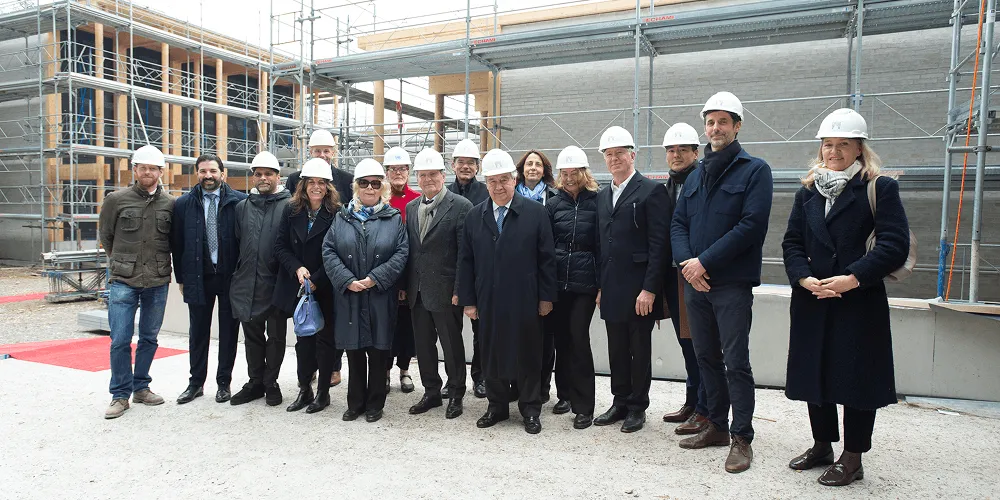
Right now, the Portail des Nations is under construction at the entrance of the Palais des Nations in Geneva—the European headquarters of the United Nations. From now on, you can follow the story online. And from March 2026, you will be able to experience it in person through an interactive, immersive journey.
No matter who you are, where you are from, what you do, or what you believe in, the Portail des Nations is for you. Step inside to explore how multilateralism works—its fundamentals, its history, its key players, its successes, its challenges—and most importantly, its impact on all of us.
Why does it matter?
Because whether we realize it or not, the decisions made in international meetings—or the failure to make them—affect every one of us.
They determine our right to clean air and safe water, to healthcare, to safety, to education, and to decent working conditions. They shape how we safeguard our individual rights, protect our communities and our biodiversity. They remain the pathway to peace.
If we want to be part of the conversations that define our future, we first need to understand how these systems work. Who is at the table. What is at stake. And how cooperation—even with all its imperfections—is still our best shot at solving global issues.
Understanding is the first step toward action. And action, together, is how we move forward.
We, the peoples of the United Nations, resonate in today’s context more powerfully than ever.
Eighty years ago, in the aftermath of war, countries came together around a simple but powerful idea: that dialogue, cooperation, and shared rules are better than conflict.
That’s how the United Nations was born—and how the Charter still guides its mission today. Of course, the UN is not perfect—but it can improve. It is a reflection of ourselves: unique, complex, sometimes frustrating, yet indispensable. It mirrors the tensions, aspirations, and contradictions of humanity as a whole.
But it remains, with its 193 Member States, the most universal tool we have to work together across borders.
Be part of something bigger
Join us today. Sign up for our newsletter. Follow us on social media. You will get behind-the-scenes insights, sneak peeks of the immersive experience, and stories about the people, and actions that make multilateralism work.
And from March 2026, come in Geneva experience it for yourself. Tickets will go on sale end of September 2025. Don’t miss the chance to step through the
Portail des Nations from day one.
Let’s open together the Portail des Nations.
Tatjana Darani
Executive Director
Portail des Nations Foundation
On the occasion of United Nations Day, we meet Ivan Pictet, initiator and president of the Fondation Portail des Nations. From his career in international finance to his long-standing commitment to international Geneva, he reflects on the genesis of a unique project: an immersive and public space designed to help people understand the role and work of the United Nations in Geneva — and, more broadly, the mechanisms of global governance.
On the occasion of United Nations Day, we meet Ivan Pictet, initiator and president of the Fondation Portail des Nations. From his career in international finance to his long-standing commitment to international Geneva, he reflects on the genesis of a unique project: an immersive and public space designed to help people understand the role and work of the United Nations in Geneva — and, more broadly, the mechanisms of global governance.
You are at the origin of the Portail des Nations concept. Where does your interest in the UN come from?
During my professional career in finance, I spent a lot of time wondering about what is happening in the world. My meeting with the UN? I chaired the investment committee of the UN Pension Fund in New York, and various economic organizations in Geneva, not to mention my commitment for more than twenty years at the head of the Fondation pour Genève.
These experiences gave me the opportunity to appreciate the importance of the United Nations presence and its ramifications for Geneva and Switzerland. In addition, institutions such as the ICRC, CERN, WTO or WEF contribute very significantly to their influence. They forged the global reputation of Geneva, the cradle of the rights of man, a place for dialogue and peace.
At what point, and why, did you decide to create the Portail des Nations ?
I often felt that Geneva lacked public spaces dedicated to understanding global governance. Back in 2008, I started imagining, together with Philippe Burrin (then Director of the Graduate Institute, IHEID), Tatjana Darani (former Director of the Fondation pour Genève), Charles Pictet, architect and Olivier Pictet, film producer, a place of learning and dialogue near the Place des Nations — where diplomats, international civil servants and students could meet, have a drink or eat their lunch on the grass, with a kiosk and screens showing live events from around the world.
My idea eventually caught the attention of the UN, which invited me to develop it within the grounds of the Palais des Nations. The prospect of creating a new kind of Visitors Centre for the United Nations Office at Geneva appealed to me, and I decided to take it on. That was in 2017. It took us two years to develop the concept and obtain the approval of the UN Member States — and a over six years to bring it to life.
Geneva hosts the largest concentration of international organizations and diplomatic missions in the world. Will it remain a place where people come together to find solutions ?
I believe so. Geneva has a vital role to play — and its importance tends to grow when the world is in trouble. In this context, Switzerland must stay the course: remaining as neutral as possible in conflicts and continuing to offer its good offices. You can see it clearly within the UN system: in New York, countries often clash over major issues that dominate attention, while in Geneva, the representatives of those same countries work together to find solutions to critical challenges that affect the functioning of our societies.
At a time when humanity is struggling to find a balance between the promises of science and technological innovation and the need to address threats to personal rights, security and privacy, I believe it is more essential than ever to offer people the opportunity to understand how global governance actually works.
The realization of the Portail des Nations project marks the culmination of a process that has taken around fifteen years. How have you seen International Geneva evolve during that time ?
From a Swiss perspective, I can see that both the federal and Geneva authorities are much more active today than they were when we first launched the project.
They are clearly aware that Switzerland’s foreign policy is largely conducted from Geneva — which is a welcome realization. Over the past three decades, Geneva has experienced unprecedented growth. I have observed a new dynamic of leadership at the head of international organizations, and genuine cooperation among UN agencies, which has made their work in the field more coordinated and effective.
And what about the future of the UN in Geneva?
Whatever shape the future of global governance takes, Geneva will remain a leading centre of diplomacy.
We can’t deny the obvious: the future of the UN depends largely on the will of its Member States. The global order is undergoing a major transformation towards what specialists call a new multipolar reality. Nevertheless, Geneva’s role as a hub of international cooperation remains intact. Nowhere else in the world can you find such diversity and concentration of expertise.
Whatever shape the future of global governance takes, Geneva will remain a leading centre of diplomacy. The need for dialogue will endure, even when agreement seems out of reach. Multilateralism will ultimately reassert itself, probably in an evolved form. The framework conditions provided by the Swiss Confederation and the Canton of Geneva will continue to be decisive. Our concept of neutrality — which is currently being debated — must reassure all nations. This neutrality remains the cornerstone of the mediating role on which International Geneva depends.
Will the opening of the future Portail des Nations have an impact on Geneva’s attractiveness ?
That is certainly our ambition — and time will tell. One thing is certain: Geneva will soon have two new infrastructures entirely dedicated to public education — the Portail de la Science at CERN and the Portail des Nations at UN Geneva. Added to that is the International Red Cross Museum, currently undergoing transformation. These unique venues and their exceptional themes will undoubtedly enhance Geneva’s appeal as a tourist and cultural destination. It will then be up to the people of Geneva to seize the opportunity and show creativity in “selling” Geneva as a city of ideas, dialogue and discovery.
Oublions un instant nos peurs sur l’état du monde, elles ne sont ni utiles, ni constructives. Le constat sur les dysfonctionnements du système onusien existe depuis plusieurs décennies, même s’il nous semble à son comble. Pourtant ce système très imparfait a survécu à l’immédiat après-guerre, à la Guerre froide, et au monde (aux mondes) d’après le 11 septembre 2001. Il n’est pas exclu que ce système ...
Let's forget for a moment our fears about the state of the world — it is neither useful nor constructive.
The shortcomings of the UN system have been acknowledged for decades, even if it now seems to us to have reached its peak. And yet, this imperfect system has survived the immediate post-war period, the Cold War, and the world(s) that emerged after September 11, 2001.
It is not impossible that it will also withstand current tensions. Ultimately, the nature of its resilience remains unknown. However, this does not mean that the silent majority should passively accept the system at hand, relinquishing the pursuit of one that is better suited to our times.
Much has been said about a crisis of multilateralism. Perhaps so. But it is not multilateralism itself that is in crisis, rather its form that is somehow evolving. In truth, multilateralism has already adapted, changed significantly, and continues to reinvent itself before our eyes. It advances through exclusions, self-exclusions, and new inclusions. It returns to more traditional forms of relations between governments, while inviting civil society and the private sector to co-participate in decision-making. The recent context of negotiations on a global treaty on plastics highlights the difficulties encountered, but it also triggers a broad awakening.
Launched by the UN several years ago, the process seems extremely slow. It is worth keeping in mind nuanced, granular analyses. While the UN Security Council may be blocked, and divided, the General Assembly has not necessarily lost its purpose. Its revitalization could come through more specific tasks or by fostering reflection on the state of the world and shared visions for its future. Could this be one of the keys to rethinking the UN system? Is there a way to reimagine this role? As for the UN
agencies, at least those based in the Geneva area, they show undeniable signs of vitality and achievement. The pandemic treaty under negotiation at WHO, despite a severe budget crisis, is a recent example.
The current great disorder is most likely temporary. Before speaking of an overhaul of the UN system, perhaps we should first take a more constructive look at the record of UN agencies (a pillar of International Geneva), of national and transnational civil society, and of national and transnational private sectors. Some of these may need to undergo painful yet perhaps necessary streamlining to
increase their effectiveness and efficiency. Others may continue their work much as they do today. Still others might undergo profound reform.
In any case, International Geneva, compelled to reinvent itself, could, and perhaps should, remain the hub for sectoral governance, integrated policy thinking, and decision-making in the general interest. It is where climate and human rights issues, global health and trade, along with other crucial matters, are debated — all in pursuit of a common goal: peace.
Indeed, might this blend of sectoral and integrated work be both the lowest common denominator and Geneva’s greatest added value, a place where peace and cooperation between nations, and between state and non-state actors alike, are shaped? Geneva’s immense comparative advantage lies in its density and diversity of actors and organisations working on the most critical issues for peace and the future of our planet: health, climate, human rights, humanitarian action, labour, trade, intellectual property, standards, and telecommunications.
Where else in the world would be better placed than Geneva to become the nerve centre for dialogue and governance on the delicate issue of regulating artificial intelligence? Or outer space? The international organisation most capable and best equipped to host such efforts already exists — why reinvent it? On the contrary, we should strengthen its resources and influence.
If it is conceivable that some international institutions have run their course, it is equally useful to imagine other scenarios. One, among others, might take inspiration from the Japanese art of kintsugi, which restores broken objects by highlighting the repairs with gold seams. This art does not aim to conceal flaws but to transform them into aesthetic features that tell the object’s story. Would it not be wise to restore with care, without discarding or trampling on what has been achieved? Not embalming, but rather injecting fresh dynamism into institutions whose core principles are sound and globally minded.
Whatever happens, let us remember that Geneva was the cradle of the first wave of internationalism, the League of Nations; it became the roots of internationalism and multilateralism in the latter half of the twentieth century and the first quarter of our own. It has the know-how, expertise, networks, density, diversity, respect for others, and the Swiss tradition of dialogue, all invaluable assets that would be costly to reproduce elsewhere.
Geneva is well placed to once again be the cradle of internationalism and new multilateralism, meant to be a pragmatic, open, inclusive, and respectful multilateralism, built on a fundamental common denominator: working to improve the human condition on our planet. And with the improvement of the human condition comes peace.
The Portail des Nations, the new UN Visitor Centre in Geneva, will open its doors in March 2026. With no complacency and through its own immersive journey, it will continue the reflection on the true challenges of a reinvented multilateralism.
Ivan Pictet
President
Portail des Nations Foundation
Press review
Deux mois et demi après son lancement, le Portail des Nations accélère, par Laurent Sierro (en français)
Monocle présente le Portail des Nations d'un point de vue architectural, par Hiba Alobaydi (en anglais)
Les atouts de Genève et du tout nouveau Portail des Nations, par Lion Grote (en allemand)
Présentation du Portail des Nations à la presse, article de Stéphane Bussard (en anglais).
La Genève internationale d’hier et d’aujourd’hui
A Genève, le Portail des Nations est inauguré, en attendant d’accueillir le public
Le Portail des Nations accueillera bientôt ses visiteurs
La Genève internationale d’hier et d’aujourd’hui
Genève est bien placée pour redevenir le berceau du nouveau multilatéralisme et promouvoir la paix
Ein Möglicher Ort für den Grossen Ukraine-Gipfel: Was genau ist eigentlich das Internationale Genf?
L’esprit de Genève, boussole d’un nouveau multilatéralisme
L’ONU Genève lance la réalisation du Portail des Nations
Nouvelle vitrine de l'ONU à Genève, le Portail des Nations est sur les rails
Genève internationale: feu vert pour le Portail des Nations